Showing posts with label E Magazines. Show all posts

Friday, 20 March 2015

International conference by IDSS

International conference by IDSS
A three day International conference on "Self, World and morality: Schopenhauer and Indian Philosophy with a special reference to the Upanishads ( Oupnek’hat)”   was held at Jawaharlal Nehru University, New Delhi by the Indian Division of Schopenhauer  Society jointly with the Philosophy department of Deshbandhu College in collaboration with the Special Center for Sanskrit Studies, JNU and the Schopenhauer Research Center of the University of Mainz, Germany. On behalf of the distinguished Schopenhauerian scholar Prof. Matthias Kossler, the President of the Schopenhauer Gesellschaft, Dr Lipprandt presented his greetings note on this occasion.

Lighting the lamp of the program by Arati Barua
A large number of foreign scholars from Germany, France and Australia and many scholars from across India assembled at the Convention Centre, JNU during 23-25  Feb 2015 to pay their tribute and respect in memory of the first significant Western Philosopher who carried the wisdom of the Upanishads and the Buddhist ideas to the Western world. Schopenhauer was deeply influenced and overwhelmed by the Indian Philosophical thought and he considered Upanishads "the solace" of his life and “solace of death" too.

Dr Arati Barua honoring the hon German Ambassador Michael Steiner with a phoolam Gamocha  on the occasion of the international women's day celebrated at his residence
Welcoming the audience, Dr. Aarti Barua, Director of the Indian Division of the Schopenhauer Society, briefly talked about the purpose of the conference and Dr Ramnath Jha  JNU, gave a thematic introduction about the seminar. Inaugurating the seminar, Honorable Prof. S K Sopory , Vice Chancellor, JNU, New Delhi, paid high tribute to Schopenhauer in his inaugural speech. Expressing deep regret that Indian scholars so far have failed to give due recognition to Schopenhauer's contribution in popularizing Indian philosophy in the West, Prof. Sopory highly appreciated the efforts taken by the SCSS and IDSS towards giving due recognition to Schopenhauer. He appreciated that the new generation of Indian scholars have recognized the void and are trying to fill it by creating an awareness about Schopenhauer's contribution amongst us. He said that the bridge Schopenhauer built to connect Indian metaphysics with Western ontology should now be strengthened.
On this occasion a Souvenir of the conference was released by the member secretary of ICPR Prof M P Singh and many distinguished scholars have sent their good wishes for the success of the conference as message for the souvenir. It was a very successful event.
A large number of distinguished participants and students were present to pay respect to Arthur Schopenhauer (1788-1860) on the occasion of his 227th birth anniversary. A special tribute was paid to Schopenhauer by garlanding his photo. Dr. Arati Barua, the chief organizer of the conference on behalf of IDSS and Special Centre for Sanskrit Studies, proposed a vote of thanks. The students chanted slokas from Upanishads  in Sanskrit which had the audience spell bound.
In the valedictory session of the Conference Prof. Shashi Prabha Kumar, V C , Sanschi University of Buddhist-Indic studies, delivered a special lecture . Dr. R N Jha, coordinator of the conference on behalf of Special Centre for Sanskrit Studies, proposed a vote of thanks to all present there. 
- See more at: http://www.assamtimes.org/node/13226#sthash.bja5qSK8.dpuf
International conference by IDSS
A three day International conference on "Self, World and morality: Schopenhauer and Indian Philosophy with a special reference to the Upanishads ( Oupnek’hat)”   was held at Jawaharlal Nehru University, New Delhi by the Indian Division of Schopenhauer  Society jointly with the Philosophy department of Deshbandhu College in collaboration with the Special Center for Sanskrit Studies, JNU and the Schopenhauer Research Center of the University of Mainz, Germany. On behalf of the distinguished Schopenhauerian scholar Prof. Matthias Kossler, the President of the Schopenhauer Gesellschaft, Dr Lipprandt presented his greetings note on this occasion.

Lighting the lamp of the program by Arati Barua
A large number of foreign scholars from Germany, France and Australia and many scholars from across India assembled at the Convention Centre, JNU during 23-25  Feb 2015 to pay their tribute and respect in memory of the first significant Western Philosopher who carried the wisdom of the Upanishads and the Buddhist ideas to the Western world. Schopenhauer was deeply influenced and overwhelmed by the Indian Philosophical thought and he considered Upanishads "the solace" of his life and “solace of death" too.

Dr Arati Barua honoring the hon German Ambassador Michael Steiner with a phoolam Gamocha  on the occasion of the international women's day celebrated at his residence
Welcoming the audience, Dr. Aarti Barua, Director of the Indian Division of the Schopenhauer Society, briefly talked about the purpose of the conference and Dr Ramnath Jha  JNU, gave a thematic introduction about the seminar. Inaugurating the seminar, Honorable Prof. S K Sopory , Vice Chancellor, JNU, New Delhi, paid high tribute to Schopenhauer in his inaugural speech. Expressing deep regret that Indian scholars so far have failed to give due recognition to Schopenhauer's contribution in popularizing Indian philosophy in the West, Prof. Sopory highly appreciated the efforts taken by the SCSS and IDSS towards giving due recognition to Schopenhauer. He appreciated that the new generation of Indian scholars have recognized the void and are trying to fill it by creating an awareness about Schopenhauer's contribution amongst us. He said that the bridge Schopenhauer built to connect Indian metaphysics with Western ontology should now be strengthened.
On this occasion a Souvenir of the conference was released by the member secretary of ICPR Prof M P Singh and many distinguished scholars have sent their good wishes for the success of the conference as message for the souvenir. It was a very successful event.
A large number of distinguished participants and students were present to pay respect to Arthur Schopenhauer (1788-1860) on the occasion of his 227th birth anniversary. A special tribute was paid to Schopenhauer by garlanding his photo. Dr. Arati Barua, the chief organizer of the conference on behalf of IDSS and Special Centre for Sanskrit Studies, proposed a vote of thanks. The students chanted slokas from Upanishads  in Sanskrit which had the audience spell bound.
In the valedictory session of the Conference Prof. Shashi Prabha Kumar, V C , Sanschi University of Buddhist-Indic studies, delivered a special lecture . Dr. R N Jha, coordinator of the conference on behalf of Special Centre for Sanskrit Studies, proposed a vote of thanks to all present there. 
- See more at: http://www.assamtimes.org/node/13226#sthash.bja5qSK8.dpuf

International conference by IDSS
A three day International conference on "Self, World and morality: Schopenhauer and Indian Philosophy with a special reference to the Upanishads ( Oupnek’hat)”   was held at Jawaharlal Nehru University, New Delhi by the Indian Division of Schopenhauer  Society jointly with the Philosophy department of Deshbandhu College in collaboration with the Special Center for Sanskrit Studies, JNU and the Schopenhauer Research Center of the University of Mainz, Germany. On behalf of the distinguished Schopenhauerian scholar Prof. Matthias Kossler, the President of the Schopenhauer Gesellschaft, Dr Lipprandt presented his greetings note on this occasion.

Lighting the lamp of the program by Arati Barua
A large number of foreign scholars from Germany, France and Australia and many scholars from across India assembled at the Convention Centre, JNU during 23-25  Feb 2015 to pay their tribute and respect in memory of the first significant Western Philosopher who carried the wisdom of the Upanishads and the Buddhist ideas to the Western world. Schopenhauer was deeply influenced and overwhelmed by the Indian Philosophical thought and he considered Upanishads "the solace" of his life and “solace of death" too.

Dr Arati Barua honoring the hon German Ambassador Michael Steiner with a phoolam Gamocha  on the occasion of the international women's day celebrated at his residence
Welcoming the audience, Dr. Aarti Barua, Director of the Indian Division of the Schopenhauer Society, briefly talked about the purpose of the conference and Dr Ramnath Jha  JNU, gave a thematic introduction about the seminar. Inaugurating the seminar, Honorable Prof. S K Sopory , Vice Chancellor, JNU, New Delhi, paid high tribute to Schopenhauer in his inaugural speech. Expressing deep regret that Indian scholars so far have failed to give due recognition to Schopenhauer's contribution in popularizing Indian philosophy in the West, Prof. Sopory highly appreciated the efforts taken by the SCSS and IDSS towards giving due recognition to Schopenhauer. He appreciated that the new generation of Indian scholars have recognized the void and are trying to fill it by creating an awareness about Schopenhauer's contribution amongst us. He said that the bridge Schopenhauer built to connect Indian metaphysics with Western ontology should now be strengthened.
On this occasion a Souvenir of the conference was released by the member secretary of ICPR Prof M P Singh and many distinguished scholars have sent their good wishes for the success of the conference as message for the souvenir. It was a very successful event.
A large number of distinguished participants and students were present to pay respect to Arthur Schopenhauer (1788-1860) on the occasion of his 227th birth anniversary. A special tribute was paid to Schopenhauer by garlanding his photo. Dr. Arati Barua, the chief organizer of the conference on behalf of IDSS and Special Centre for Sanskrit Studies, proposed a vote of thanks. The students chanted slokas from Upanishads  in Sanskrit which had the audience spell bound.
In the valedictory session of the Conference Prof. Shashi Prabha Kumar, V C , Sanschi University of Buddhist-Indic studies, delivered a special lecture . Dr. R N Jha, coordinator of the conference on behalf of Special Centre for Sanskrit Studies, proposed a vote of thanks to all present there. 
- See more at: http://www.assamtimes.org/node/13226#sthash.bja5qSK8.dpuf
International conference by IDSS
A three day International conference on "Self, World and morality: Schopenhauer and Indian Philosophy with a special reference to the Upanishads ( Oupnek’hat)”   was held at Jawaharlal Nehru University, New Delhi by the Indian Division of Schopenhauer  Society jointly with the Philosophy department of Deshbandhu College in collaboration with the Special Center for Sanskrit Studies, JNU and the Schopenhauer Research Center of the University of Mainz, Germany. On behalf of the distinguished Schopenhauerian scholar Prof. Matthias Kossler, the President of the Schopenhauer Gesellschaft, Dr Lipprandt presented his greetings note on this occasion.

Lighting the lamp of the program by Arati Barua
A large number of foreign scholars from Germany, France and Australia and many scholars from across India assembled at the Convention Centre, JNU during 23-25  Feb 2015 to pay their tribute and respect in memory of the first significant Western Philosopher who carried the wisdom of the Upanishads and the Buddhist ideas to the Western world. Schopenhauer was deeply influenced and overwhelmed by the Indian Philosophical thought and he considered Upanishads "the solace" of his life and “solace of death" too.

Dr Arati Barua honoring the hon German Ambassador Michael Steiner with a phoolam Gamocha  on the occasion of the international women's day celebrated at his residence
Welcoming the audience, Dr. Aarti Barua, Director of the Indian Division of the Schopenhauer Society, briefly talked about the purpose of the conference and Dr Ramnath Jha  JNU, gave a thematic introduction about the seminar. Inaugurating the seminar, Honorable Prof. S K Sopory , Vice Chancellor, JNU, New Delhi, paid high tribute to Schopenhauer in his inaugural speech. Expressing deep regret that Indian scholars so far have failed to give due recognition to Schopenhauer's contribution in popularizing Indian philosophy in the West, Prof. Sopory highly appreciated the efforts taken by the SCSS and IDSS towards giving due recognition to Schopenhauer. He appreciated that the new generation of Indian scholars have recognized the void and are trying to fill it by creating an awareness about Schopenhauer's contribution amongst us. He said that the bridge Schopenhauer built to connect Indian metaphysics with Western ontology should now be strengthened.
On this occasion a Souvenir of the conference was released by the member secretary of ICPR Prof M P Singh and many distinguished scholars have sent their good wishes for the success of the conference as message for the souvenir. It was a very successful event.
A large number of distinguished participants and students were present to pay respect to Arthur Schopenhauer (1788-1860) on the occasion of his 227th birth anniversary. A special tribute was paid to Schopenhauer by garlanding his photo. Dr. Arati Barua, the chief organizer of the conference on behalf of IDSS and Special Centre for Sanskrit Studies, proposed a vote of thanks. The students chanted slokas from Upanishads  in Sanskrit which had the audience spell bound.
In the valedictory session of the Conference Prof. Shashi Prabha Kumar, V C , Sanschi University of Buddhist-Indic studies, delivered a special lecture . Dr. R N Jha, coordinator of the conference on behalf of Special Centre for Sanskrit Studies, proposed a vote of thanks to all present there. 
- See more at: http://www.assamtimes.org/node/13226#sthash.bja5qSK8.dpuf

See details

Friday, 13 March 2015

Browse or search, in Sanskrit!


Personality
 
Suganthy KrishnamachariDr. P. Ramanujan. Photo: G.P. Sampath Kumar

Dr. P. Ramanujan. Photo: G.P. Sampath Kumar

Thanks to Ramanujan’s effort, one can now access Sastras through the computer.

(This is the first of a two-part article on Dr. P. Ramanujan’s work on Sanskrit and computers)
In the late 1920s, Ghanapathi Parankusachar Swami won a prize in Sanskrit. When asked whether he wanted the prize of Rs 3,000 in cash or kind, he asked for books! Thus he acquired a wonderful library. This enabled his son Ramanujan to pore over the books every day.
Ramanujan spent seven years putting the contents of the Sastras into a database. He culled 30,000 sutras from all the Sastras, classified the different aspects of the Sastras, and gave his compendium the name, Sakala Sastra Sutra Kosa.
When a retired professor of Physics from IIT Madras, who became a sanyasi after being initiated by Sringeri Pontiff, Paramananda Bharati, organised a conference in Delhi on Sanskrit and Computers, Ramanujan told him about the kosa and was asked to present a paper at the conference.
The paper was on using computers for Sanskrit. Many IIT professors were present and what caught their attention was that Ramanujan had come up with a flow chart in Sanskrit, and a programme for the generation of nouns. The then President of India, Dr. Shankar Dayal Sharma, was so impressed that he suggested that Dr. Bhatkar- founder director of Centre for Development of Advanced Computing (C-DAC) - make use of Ramanujan’s services. In 1990, Ramanujan joined C-DAC, Pune. While in Pune, Ramanujan developed DESIKA, a comprehensive package for generating and analysing Sanskrit words.
What does DESIKA do? “Given a Sanskrit word, it gives you the hidden meanings, the meanings with which it is packed. Key in a word and DESIKA gives you the noun attributes like paradigm, ending type, noun base, number and case, and similarly for verbs.”
When Ramanujan joined C-DAC, their ISCII standard was in the testing stage. Ramanujan wrote the Vedic part of the standard.
Around this time, a question was raised in Parliament about what Indian scientists were doing in the field of Computers and Sanskrit. Ramanujan was asked to make a presentation in Parliament. He presented DESIKA, and later gave a demo in the Parliament annexe. The then Prime Minister P.V. Narasimha Rao, who held the Science and Technology portfolio, attended the demo and was amazed at the simplicity of DESIKA.
Ramanujan made a second presentation in Parliament in 1993. The question now was about how to handle differences between Vedic and classical Sanskrit. Ramanujan replied that this would pose no problems, and showed a 73 by 26 matrix, which he had prepared (73 individual characters in the Vedic part and 26 parameters). For every Vedic syllable, there are three components- consonant, vowel and accent, and each syllable has 26 parameters, which define it fully.
In 1994, C-DAC began work on Vedic fonts and today, all the Vedas have been rendered machine readable. Searchable, analysable Sastraic contents, Itihasas, Puranas, Divya Prabandham are all now available too, with value added features such as retrieval as word, stem, compounds, including Boolean search. You can use the same keyboard layout for any script.
Ramanujan entrusted to students of Veda Pathasalas, the task of typing out old texts. “One lakh pages have been typed, and 600 texts covered. But the task of annotation still remains, because there are not enough knowledgeable people to do the job.”
Aren’t people who study for many years in pathasalas competent to do this? “Not necessarily. Most of the pathasalas concentrate on rote learning. I feel we can dilute the memorising part and concentrate on analysis. We need to make this kind of study monetarily attractive as well.”
Ramanujan was the Principal Investigator for the TARKSHYA (Technology for Analysis of Rare Knowledge Systems for Harmonious Youth Advancement) project, which envisages providing Sanskrit institutions across the country with high speed connectivity, for promoting heritage computing activities. Content has also been developed for online study. Three courses have been designed: Vedic processing, Sastras and manuscript processing. “We have video lectures by 40 scholars. Students can access the lectures through their mobiles. If a student wants to search something later, he can do so, for a verbatim transcript is available.”
For manuscript processing, a computer application program, called Pandu-lipi Samshodaka has been developed by C-DAC, which has browse, search, index, analyse and hyperlinking features.
Ramanujan takes me round his library, which has many rare manuscripts, some of them more than 400 years old. They have all been digitised. He feels students must seek out old manuscripts, for who knows what treasures lie hidden in them?
How can we tweak education for students of traditional learning? “A student of Indian logic should study Western logic too. A student of vyakarana must study modern theories of linguistics. Study should be interdisciplinary- mathematics in ancient Sanskrit texts and in modern texts; transdisciplinary- that is different areas within Sanskrit such as vyakarana, mimamsa, nyaya; multi disciplinary- a student of ayurveda could perhaps study the therapeutical aspects of music.”
Helpful for scholars
Ramanujan has a website parankusa.org, in which he gives the Arsheya system for the Krishna Yajur Veda. This is a topical arrangement of contents. What is actually followed today is the Saarasvatha system, which does not have such an ordering. Giving the Arsheya system alongside the Saarasvatha ordering, has been of great help to many Sanskrit scholars.
Keywords: SastrasSanskritDr. P. RamanujanVedas,


See details

Sunday, 8 March 2015

Delhi Confidential: Last laugh


Manoj Tiwari, Kiran Bedi, Delhi elections, Smriti Irani, Ramesh Bidhuri, Mallikarjun Kharge, BJP, Congress, Kiran Bedi
By: Express News Service | New Delhi | Published on:February 25, 2015 1:02 am
North East Delhi MP Manoj Tiwari has all of a sudden become a hero. MPs from BJP as well as other parties were seen praising him for his “political acumen” in foreseeing BJP’s poor show in the Delhi elections under Kiran Bedi. While Petroleum Minister Dharmendra Pradhan suggested that Tiwari should encash his new stature and host a ‘Holi Milan’, NCP MP Supriya Sule praised him for being the “first BJP leader” to publicly criticise the projection of Bedi as CM during Delhi elections. As Tiwari struggled to hide his glee, a slightly envious Ramesh Bidhuri tried to temper the mood saying none of the BJP candidates from Poorvanchal region got elected. Tiwari asked him to name the candidates who won from his area.
Nishikant, Nitish or Nishant?
Congress leader Mallikarjun Kharge, while speaking during the motion of thanks on the President’s address, had both the Treasury and the Opposition benches in splits when he kept on forgetting Godda MP Nishikant Dubey’s first name. Dubey had spoken just ahead of Kharge and the Congress leader had to refer to several of the Jharkhand MP’s remarks during his speech. First he referred to him as Nitish. When corrected, he tried saying that both Nitish and Nishikant were his good friends. A while later, he was at it again, this time referring to Dubey as Nishant.
Records on offer
Lok Sabha MPs who want to have video recordings of their respective speeches, participation or intervention in the House proceedings would no longer have to sweat it out to procure them. The Audio-Visual Unit of the Lok Sabha Secretariat plans to make available copies of Lok Sabha proceedings to members in the form of two-hour long DVDs at Rs 100 per copy. The MPs will just need to send their requests indicating the date, time and subject of their participation to avail these recordings.
Expert advice
The HRD Ministry’s focus on preserving and promoting Indian languages, especially Sanskrit, is clear from the inclusion of a language expert in the ministry’s team in an advisory capacity. Chamu Krishna Shastry of the Sanskrit Promotion Foundation, who pioneered the Speak Sanskrit Movement, has been advising the ministry and HRD Minister Smriti Irani on matters related to languages on a regular basis and is seen in the ministry almost everyday. Shastry recently also travelled with the minister to Chennai on Matribhasha Diwas.see details

Sanskrit qawwali durbar


Napoleon was cent per cent right when he said that the word impossible is found only in the dictionary of fools. Actor Anupam Kher's television show "Life Mein Kuchh Bhi Ho Sakta Hai" (anything is possible in life) vindicates the French military leader's dictum.
A few days ago, I read in an English daily that a cyber geek had translated the dialogues of Bollywood classic 'Sholay' into Sanskrit. It seems amusing to imagine Gabbar Singh, the formidable bandit character in the film, mouthing those killer dialogues in the ancient language of holy texts.
It catapulted me to the time about a decade ago when I was at a seminar on "Challenges before Punjabi language in the 21st century" at Punjabi University, Patiala. Speaking on the topic, a noted prose writer said Punjabi had ample opportunities to flourish as a cultural language, while as a medium of instruction and intellectual debate, it had limitations.
His frank statement hurt some members of the audience who took pride in their mother tongue. The hall started buzzing with murmurs. About half a dozen scholars vented their ire against the sacrilege. Now it was the turn of the erudite gentleman who had made the observation to clarify. All smiles, he ascended the podium and said: "Friends, I am firm on my stand and reiterate with all responsibility and commitment that intellectual discussion in Punjabi is not possible.
This is no handicap of the language but just as you can't have qawwali in Sanskrit." The listeners had a good laugh and broke for lunch.
Hardly a week later, I found in my mail an invite from the languages department to an inter-school Sanskrit qawwali contest. I remembered the learned author who had dismissed the possibility, and an itch struck me to ring him up. I asked him to accompany me to the event and see for himself the marvel. As is the wont of scholars, he didn't budge an inch from his stand, and said children must have mixed a little bit of Sanskrit in their song compositions.
He didn't accompany me but I sat curious all through the contest. To my wonder, I found the schoolchildren at professionals-like ease while presenting Sanskrit qawwalis at the beat of claps. It was a moment of revelation, when my belief became firmer that anything is possible in life. parvesh.sharma184@gmail.com
see details 

Chanting of Sanskrit Mantras to open Idaho Senate on March 3


February 25,2015, 10.09 AM  IST | | THE HANS INDIA
Idaho Senate, upper house in the State Legislature, will start its day with ancient Hindu mantras on March third, said to be a first since Idaho acquired statehood in 1890.


This reportedly historic invocation will contain verses from Rig-Veda; the oldest existing scripture of the mankind still in common use.
 
Hindu statesman Rajan Zed will deliver this prayer from Sanskrit scriptures before the Senate. After Sanskrit delivery, he then will read the English translation of the prayer. Sanskrit is considered a sacred language in Hinduism and root language of Indo-European languages.
 
Zed, who is the President of Universal Society of Hinduism, besides Rig-Veda, will also recite from Upanishads and Bhagavad-Gita (Song of the Lord), both ancient Hindu scriptures. He plans to start and end the prayer with “Om”, the mystical syllable containing the universe, which in Hinduism is used to introduce and conclude religious work.
 
Reciting from Brahadaranyakopanishad, Rajan Zed plans to say “Asato ma sad gamaya, tamaso ma jyotir gamaya, mrtyor mamrtam gamaya”, which he will then interpret as “Lead us from the unreal to the Real, Lead us from darkness to Light, Lead us from death to immortality.” Reading from Bhagavad-Gita, he proposes to urge the Senators to keep the welfare of others always in mind.
 
Zed is a global Hindu and interfaith leader, who besides taking up the cause of religion worldwide, has also raised huge voice against the apartheid faced by about 15-million Roma (Gypsies) in Europe. Bestowed with World Interfaith Leader Award; Zed is Senior Fellow and Religious Advisor to Foundation for Religious Diplomacy, Spiritual Advisor to National Association of Interchurch & Interfaith Families, etc. He was invited by President of European Parliament in Brussels (Belgium) for a meeting to promote interfaith dialogue.
 
Hinduism, oldest and third largest religion of the world, has about one billion adherents and moksh (liberation) is its ultimate goal. There are about three million Hindus in USA.
 
Lieutenant Governor Brad Little presides over Idaho Senate in Boise which has 35 members, while Brent Hill is its President Pro Tempore. C.L. "Butch" Otter is Governor of Idaho, whose nickname is "The Gem State" and tagline "Adventures in Living". Idaho claims to be number one national producer of potatoes, trout, Austrian winter peas and lentils; and is known for its pristine wilderness, Lava Hot Springs and Sun Valley ski resort.

A strong pitch to increase Wikipedians' tribe in Sanskrit


Shruthi H M, Feb 25, 2015, Bengaluru, DHNS
Tech-enabling
 There have been several efforts to keep Sanskrit alive in popular culture. A team of Wikipedians in the City has now joined this endeavour. Reuters File Photo.
 There have been several efforts to keep Sanskrit alive in popular culture. A team of Wikipedians in the City has now joined this endeavour.

They are doing their bit for the language by working towards the expansion of Sanskrit Wikipedia. Roping in college professors and students to actively contribute to Sanskrit Wikipedia, the team is spearheading a movement for popularising Sanskrit Wikipedia, Wikisource, Wiktionary and Wikiquote.

In a first such workshop on ‘Samskrit Wiki’ organised by the Samskrit Wiki Group here on February 14 and 15, 2015, Sanskrit professors were given basic understanding about Wikipedia editing.

Professors from Rashtriya Samskrit Samsthan (Sringeri and Puri campuses), Rashtriya Samskrutha Vidyapeetham, Tirupathi, Karnataka Sanskrit University, Samskrit Academy (Hyderabad), participated in the event apart from Sanskrit lecturers from several colleges in the city. These professors will henceforth actively contribute towards enriching Sanskrit Wikipedia.

The Samskrit Wiki Group is based out of Samskrita Bharati in the City. Content development of Sanskrit wikipedia is one of the projects of Samskruta Bharati. Speaking to Deccan Herald, Shubha, co-ordinator of the Samskrit Wiki wing, Samskrita Bharati, said that they had conducted several exhibitions earlier in this connection, but this was the first such workshop being held.

“Many of the participants had not heard of Sanskrit Wikipedia. People usually associate Wikipedia with information available in English. Not many people are aware about Wikipedia in regional languages. Very few know that Wikipedia also exists in Sanskrit,” she said.

Wiki-friendly students

Now that the professors have been trained, the group will visit the educational institutions and start training students too, so that they can contribute for Sanskrit Wiki.
This would also give them an opportunity to enhance their writing skills in Sanskrit. Shubha said that several Sanskrit students were not tech-friendly and were not used to computers. This would expose them to technology.

The team was also keenly pursuing advocating inclusion of Wiki editing in BEd and MEd syllabus, apart from its inclusion in ‘Acharya,’ a Sanskrit degree equivalent to post-graduation.

‘Need more experts’

The main challenge in expansion of Sanskrit Wikipedia is that there are not many language experts available for the task. The volunteers need to find relevant Sanskrit words for several modern concepts. Unless one is an expert in the language, it is difficult to find the appropriate words.

 “It is not a mother tongue for most people. If one wants to write in their mother tongue, they need not think much. But this requires effort,” Shubha pointed out.

Sanskrit Wikipedia began in 2003. The Samskrit Wiki Group team started working towards expansion of Sanskrit Wikipedia in February, 2011. When they began, there were 4,000 articles in Sanskrit Wikipedia. “Several entries were in Hindi and we had to translate and rework on them,” Shubha told Deccan Herald.

Today there are about 11,000 articles in Wikipedia, about 8,000 books in Wikisource and about 3,000 pages of Wiki quote in Sanskrit, she said. see details

Idaho Senate to open with its 1st Hindu prayer

Rajan
Idaho Senate, upper house in the State Legislature, will start its day with ancient Hindu mantras on March third, said to be a first since Idaho acquired statehood in 1890.
This reportedly historic invocation will contain verses from Rig-Veda; the oldest existing scripture of the mankind still in common use.
see details

Pitch to increase Wikipedians' tribe in Sanskrit


Shruthi H M , Feb 27, 2015 Bengaluru, DHNS:
There have been several efforts to keep Sanskrit alive in popular culture. A team of Wikipedians in the City has now joined this endeavour.

They are doing their bit for the language by working towards the expansion of Sanskrit Wikipedia. Roping in college professors and students to actively contribute to Sanskrit Wikipedia, the team is spearheading a movement for popularising Sanskrit Wikipedia, Wikisource, Wiktionary and Wikiquote.

In a first such workshop on ‘Samskrit Wiki’ organised by the Samskrit Wiki Group here on February 14 and 15, 2015, Sanskrit professors were given basic understanding about Wikipedia editing.

Professors from Rashtriya Samskrit Samsthan (Sringeri and Puri campuses), Rashtriya Samskrutha Vidyapeetham, Tirupathi, Karnataka Sanskrit University, Samskrit Academy (Hyderabad), participated in the event apart from Sanskrit lecturers from several colleges in the city. These professors will henceforth actively contribute towards enriching Sanskrit Wikipedia.

The Samskrit Wiki Group is based out of Samskrita Bharati in the City. Content development of Sanskrit wikipedia is one of the projects of Samskruta Bharati. Speaking to Deccan Herald, Shubha, co-ordinator of the Samskrit Wiki wing, Samskrita Bharati, said that they had conducted several exhibitions earlier in this connection, but this was the first such workshop being held.

“Many of the participants had not heard of Sanskrit Wikipedia. People usually associate Wikipedia with information available in English. Not many people are aware about Wikipedia in regional languages. Very few know that Wikipedia also exists in Sanskrit,” she said.sww details

The Way Things Were’, by Aatish Taseer


A Sanskrit scholar delves into his parents’ past in an engrossing state of the nation novel
There is a distinctive strain in Indian fiction that takes as its subject the family group and weaves from it overarching novels that embrace great swathes of India’s history and politics. Neel Mukherjee, Jhumpa Lahiri, Salman Rushdie, Amitav Ghosh and Vikram Seth are among the most notable writers to have turned a state of the family novel into a state of the nation one. Aatish Taseer is another.
Taseer’s approach in The Way Things Were is to adopt the simplest of devices, the story of a marriage and its dissolution as narrated by a son, and use it to show an India that, in its brashness, narrow-mindedness and readiness to be swayed by rightwing ideologues, has lost all touch with its past. It is an India that will look to everywhere but its own history for a role model: “Every time there’s an ascendant power in the world,” says the central character, “India will remake itself in its image.”


FirstFT is our new essential daily email briefing of the best stories from across the web
The marriage is that between Toby, a half-Indian, half-Scottish scholar of Sanskrit, and Uma, a member of Delhi’s gossiping and bitching “Lutyens elite”. At the opening of the novel Toby has died and his son Skanda has brought the body back to India, the country Toby had left some decades earlier, for cremation and the scattering of the ashes. Toby was a minor prince, the raja of “a tin-pot kingdom, not worth an air-gun salute”, and the return to his ancestral lands is what prompts Skanda to narrate his parents’ story and, with it, the past 50 years of India’s, too.
Skanda, like his father, is a student of Sanskrit and, when the news of Toby’s death arrives, he is in the middle of translating The Birth of Kumara, a 5th-century epic poem by Kalidasa describing the loves of the gods: the novel’s human story mirrors that of the divine. “The true genius of Ancient India was language,” says Toby, and Sanskrit was the most refined of its 20 or more tongues, a literary and liturgical language of infinite subtlety. For Toby, it offers hope that the rarefied sensibilities of those who spoke and wrote it might re-emerge in a modern Indian renaissance. For Skanda, it offers a series of etymological challenges that might help him frame a narrative for his own history.
Taseer constructs his story around a cluster of violent events that give the lie to Toby’s and Skanda’s vision of a still viable poetic tradition: the Emergency of 1975, when Indira Gandhi, India’s prime minister, suspended numerous civil liberties; the 1984 riots in response to her assassination, which saw Sikhs burned alive in the streets; and the Hindu destruction of the Babri mosque at Ayodhya in 1992. Each outburst shakes the elite metropolitan world of which Toby, through marriage, is a reluctant part and opens cracks in his scholarly detachment: as he is warned ominously, “in certain places fineness of feeling is indistinguishable from weakness”.

The upheavals also open cracks in Toby and Uma’s marriage, and a series of domestic set pieces — a drunken party where home truths are told, the imprisoning and humiliation of Uma’s refined brother, a beating — widen them until there is nothing to prop up the marriage: “It was the tragedy of their marriage — of all failed marriages perhaps — that so much was known, and nothing could be done.”
As Skanda’s Sanskrit teaches him, everything is interlinked. His mental tic is to trace cognates — words of different languages having the same derivation — so that when he hears the word “night”, for example, he traces it from nakta in Sanskrit, to nox in Latin, nux in Greek, Nacht in German, and naktis in Lithuanian. It is an elegant metaphor for the way that while words have roots, people can lose theirs.
Taseer is fascinated by language to the point that his characters speak in fully formed philosophical paragraphs rather than a naturalistic vernacular. What they say here, though, about India, love, family and the accommodations inherent in every life, is intensely engrossing. What he has done with great intelligence and elegance is to deliver a novel of ideas in the guise of a very human storysee details

Make it New

A 16th century painting based on the Gitagovindam. A 16th century painting based on the Gitagovindam.
Updated: February 28, 2015 1:10 am
Book: Innovations and Turning Points, Toward a History of Kavya Literature
Edited by: Yigal Bronner, David Shulman and Gary Tubb
Publisher: Oxford University Press
Pages: 820
Price: Rs 1295
Review By Bibek Debroy
Sanskrit literature has a gigantic corpus and there are multiple ways to slice it. Much of it is technically in poetry (kavya). Within the kavya genre, as opposed to say plays, biographies or satire, there are mahakavyas, great kavyas. There is a specific definition of what constitutes a mahakavya, but one can ignore that for now. The great poets who composed mahakavyas (there is a list of six mahakavyas) are Kalidasa, Bharavi, Magha, Sriharsha and Bhatti. Unless one has a great interest in Sanskrit poetry, most people would probably choose their favourite poet from this list. Just so that it is clear, Valmiki and Vedavyasa belong to a different era. They are pre-classical. This volume is about kavya, lyrical works that fall short of being mahakavyas, but nevertheless have enough in them to transcend the prosaic. For example, Jayadeva’s Gitagovindam is kavya, not a mahakavya. This edited volume, with an excellent introduction, emerged from a conference in 2003-04. The idea is the following: can one identify poets (and their works) that lead to a breakthrough in innovation? “If… we read Sanskrit kavya with an open mind, we see evidence of tremendous vitality and continuous change. What is more, the notion of innovation is a remarkably consistent topos throughout the classical and medieval literature. The poets themselves very often remark on the novelty of their own work as well as that of particular poets who came before them.”
This is a novel idea and the introduction succinctly explains how “change” can be pinned down and rendered less subjective. The 25 papers are divided into seven heads — ‘Introduction’, ‘Kalidasa and Early Classicism’, the ‘Developing Mahakavya’, ‘Masters of Prose’, ‘Sons of Bana’, ‘Poets of the New Millennium’ and ‘Regional Kavyas’. Each paper then covers a specific theme, work or poet.Though the listing of novelty and innovation is never meant to be exhaustive, I do have a complaint about Jayadeva’s exclusion. On several counts, Gitagovindam also broke new ground. A more serious complaint is about the style of some essays. They are written in a dry, boring and academic style. They might have been excellent, seen through the lens of an academic conference. From the point of view of a book that seeks to generate popular interest in Sanskrit kavya, they should have been substantially rewritten. The ‘Introduction’ is what holds the book together. As I have said, it is excellent, learned without being pedantic, a style all other essays should have followed.
As is perhaps inevitable, three essays in Part 2 are about Kalidasa – specifically Kumarasambhavam and Raghuvamsha, with a more general piece about the taxonomy and structure of a mahakavya. Part 3 is about Bharavi, Magha continued…SEE DETAILS

An insatiable Telugu fan from Germany


P. Sujatha Varma
 
  • Savouring Telugu flavours: Stefan Binder from Germany. —Photo: V. Raju
  • Savouring Telugu flavours: Stefan Binder from Germany. —Photo: V. Raju
    Savouring Telugu flavours: Stefan Binder from Germany. —Photo: V. Raju
There is a Chinese proverb which says learning is a treasure that will follow its owner everywhere.
Stefan Binder of South Germany is an insatiable learner basking in the glory of Telugu language in Vijayawada city. A student of cultural anthropology back home in Berlin where he lives, his first visit to India was a couple of years ago.
“As part of my Masters, I started learning Telugu and Sanskrit and in the last semester, I opted for Telugu. By the end of it, I was able to translate Telugu in German,” he says.
Starting with locals
And then, he started learning the language on his own. In the beginning, he had problem in speaking Telugu with locals but later got used to it.
By sheer coincidence, he landed in Andhra Pradesh for his research project. “The Telugu taught in the university was very technical unlike the colloquial one. Now I am confident of striking a conversation in Telugu, even if it is about my research project,” says the 29-year-old scholar with an emphatic nod. Ask him about the most difficult part of Telugu and he points to its “syntactic structure which is different from European languages. “Theoretically I can understand it,” he hastens to add. The best part, he says, is that the Telugu grammar is not too complex compared to Sanskrit or “my own mother tongue German.” Give him a lot of time and a dictionary and he can translate Sanskrit too. “Actually, my Hindi is better but my vocabulary is shrinking because of late, I have been focusing only on Telugu,” he says.
Films his passion
He enjoys watching Bollywood films. “ P.K and Haider were the latest ones and I also plan to see Dum laga ke haisha ,” he adds. As far as food is concerned, the German youth is having a delicious time tucking into his favourite dosas in breakfast and delicacies like pulusu (gravy) made with sweet potato and ladies finger. “I love the combination of mudda pappu (dal) and allam pachchadi (ginger pickle) with ghee,” his smile returns.Mr. Binder calls his visit a learning experience. “My first visit was to an undivided Andhra Pradesh. I returned after a gap to find two different States with boundaries redrawn. I have friends on both sides. But regardless of physical barriers, I find the emotional chord intact,” he says.
As part of my Masters, I started learning Telugu and Sanskrit and in the last semester, I opted for Telugu. By the end of it, I was able to translate Telugu in German
Stefan Binder
German studentsee details

Language Learning Update


Amazingly it’s been around seven years since I first started stumbling towards learning Hindi.
For those who are new here is some background: my parents study Sanskrit and so I grew up with some influence of that. I knew the letters of the devanagari alphabet (which both Sanskrit and Hindi use) by the time I was in college. I knew some Vedic prayers. I had a little kid’s learn Sanskrit book from the St. James school (affiliated with SES). The one I had is Stories of Krishna part one. Back then I discovered that language was difficult for me to learn. I took years of Spanish classes in school too but my introversion was crippling and it slowed me down so much that I switched to Latin. That came with its own problem when I discovered that I have a tendency to gloss over details and focus on the big picture of things. That habit of my brain serves me well in a lot of ways but it made getting accurate translations of Latin or Sanskrit nearly impossible.
Still, I loved languages and I wanted to be fluent in multiple languages. In college I loaded up on linguistics classes. I also took American Sign Language classes. That was a break through for me. I loved ASL in a way that made me long for it when I wasn’t using it. I learned quickly and the grammar made sense to me. It all clicked. Maybe that was the immersive classroom. Our teacher used only ASL to teach us. What stopped me before I got fluent in ASL was politics. I’m sorry that I gave up on it, though, and I still long for it. I’d like to go back to working on that language. (And Memrise has a great course for it!)
In college I also tried a Sanskrit class but my advantage of familiarity was over by the second class and the pace was far too fast. Sanskrit is very intensive in its grammar and the goal in the class was to learn all the grammar in one semester. I barely passed.
At that time I was starting to become more and more involved in Indian culture and not just philosophy. I had a number of Hindu friends (as well as a few Sikh friends, but that’s beside the point) and I realized that maybe Hindi would be the perfect language for me to choose to learn. It was a language most likely to help me speak to people.
And so it began. I discovered a love for Hindi and it motivated and continues to motivate me through challenging times.
Over the last seven years there have been times when I wasn’t studying very much at all and there have been others times when I’ve devoted nearly every waking hour to it, from course books to Rosetta Stone to classes to movies without subtitles. Indian friends told me it was an easy language to learn. Just watch lots of movies, they said. (Rosetta Stone, by the way, was the best thing I did. It taught me more than every other resource put together).
But I still struggle. I am not fluent. I can understand a lot of simple sentences but as soon as I try to follow Twitter arguments in Hindi I’m completely lost. I can speak some easy conversational plesantries but I can’t truely express myself in Hindi.
I’ve been practicing writing simple sentences based on Youtube lessons from my friend who runs Hindi University but even then I find that nearly every sentence I write has a problem with it. Usually that I’ve left out or misused connecting words. And then I feel just so overwhelmed by how much is still ahead of me. Once I figure out how to use connecting words correctly then I’ve still got to learn all kinds of idioms and expressions before everyday conversation will make sense to me. At least I am at a point where I can make myself understood usually.
On top of all that, on my last trip to India I realized that Hindi is not very practical to my life. The fact is, I don’t have any connection to North India. Just about everyone I know is from the South, all the activities I do are Southern based, my temple is Southern, my guru is in the South. When I travel to see the guru I don’t get to use my Hindi at all. No one speaks it. It’s all either Tamil or Kannada in that area.
I know that I can practice with real people because when I meet people who don’t speak English I do try out using my Hindi. But I get the same blank looks.
So I realized that if I want to really be able to speak to people and to arrange my own trips to see my guru, it would be very useful to know Tamil and maybe some Kannada too.
And so I have started learning another language without knowing if I’ll really be able to do it. Hoping that I’ll get further than I have with Hindi (not that I’m giving up on Hindi). Luckily I have a friend who is both a school teacher and a native speaker/lover of Tamil. She got me started with the alphabet and some phrases. She’s going to continue to help me along the way and I have several other friends in the area who are native Tamil speakers too.
Sadly, Rosetta Stone does not have a Tamil program (help me out, put in a request here!) and they are by far my favorite way to learn. So I’ve been working on recreating their system on Memrise. It’s pretty slow going, though!
Because of my expanded language learning, the Learn Hindi tab at the top of this post has been changed to Learn Hindi/Tamil/Sanskrit. On that tab you will find all the resources that I’ve gathered for all three of these languages.see details

Schrödinger’s Cat and Shiva’s Dance


GEEK SUBLIME: THE BEAUTY OF CODE, THE CODE OF BEAUTY by Vikram Chandra. 2014. Graywolf Press. 236 pages.

In the closing paragraph of the thoroughly researched, magnificently integrated, (and awkwardly titled) Geek Sublime, Vikram Chandra writes, “My writing life and my life with computers, in spite of their differences, seem mirrored, twinned. Both are explorations of process, of the unfolding of connections. Both reward curiosity, dogged patience. And perhaps it is just the double presence that I cherish, of art and logic, of deep historical roots and newness ... It has been pointed out to me that my fiction proliferates doubles, couplings, alter egos, layers within layers.”
This ambitious book is actually two books in one, twins of mixed parentage, midwifed by an author who epitomizes the “Yes, and” ethos.  Not content with an exploration of how computing software is developed and deployed in our hyper-networked world connected by layers and layers of programming code, Chandra pre-figures the modern state of coding with the palimpsest that is Sanskrit, the undying language of the ancients.  YES, software drives so much of the world we live in, AND there is a beauty to how the underlying code is designed.  YES, Sanskrit was designed by linguists and poets as a beautiful devavani  (“language of the gods”), AND it was coded as a systematic structure that on crumbling palm-leaf manuscripts would be “eternal, uncreated.”
The first third of Geek Sublime is focused on software development. But these pages will not teach you how to set up a website. Instead, they explore the innards of the system that enables the website (including a helpful set of binary logic gate diagrams that serves as a primer on how the digits “0” and “1” compute based on Boolean logic operators). More importantly, this introductory part of the book explores what makes the computer’s interior software landscape ugly or beautiful. Donald Knuth, the so-called “father of algorithms,” who wrote a wide-reaching, multi-volume, series titled The Art of Computer Programming, helps to contrast two types of code:
“Knuth remarked about the code of a compiler that it was ‘plodding and excruciating to read, because it just didn’t possess any wit whatsoever.  It got the job done, but its use of the computer was very disappointing.’”
“To get the job done—a novice may imagine that this is what code is supposed to do.  Code is, after all, a series of commands issued to a dumb hunk of metal and silicon and plastic animated by electricity.  What more could you want it to do, to be?  Knuth answers: code must be ‘absolutely beautiful.’  He once said about a program … that ‘reading it was just like hearing a symphony, because every instruction was sort of doing two things and everything came together gracefully.’”
For those who earned their programming chops in the last century (as I did), the references to The Art of Computer Programming, (as well as Kernighan and Plauger’s The Elements of Programming Style, Wirth’s Algorithms + Data Structures = Programs, and others) are a trip down memory lane.  There are even a few lines of code from computer languages such FORTRAN.  Although this bit of nostalgia is a bit of a kick for old-timers, perhaps the most important part of the first part of the book is the myth-busting section about computing’s macho culture.
This anthropological history opens innocently enough with a contrast of the singularly heroic “Einstein” programmer/priest who “understands the machine so well that he programs in machine code” and the plebian “millions of Morts who have benefitted from the computer revolution [and] produce awful, bloated, buggy software because they don’t know how the machine really works.
It’s as if Chandra is asking the reader to suspend disbelief and accord software and Sanskrit the “brother of another mother” sibling relationship.  The second third of the book, which superficially seems best suited to grammarians, slyly argues for a god-like machine metaphor driving both Sanskrit and software aesthetics:  “The systematic, deterministic workings of these rules may remind you of the orderly on-and-off workings of logic gates.  The Ashtadhyayi [a 500 BCE text authored by Panini, who in influential ways, was the father of ancient and modern linguistic theory and thus indirectly the father of computer languages] is, of course, an algorithm, a machine that consumes phonemes and morphemes and produces words and sentences.  Panini’s machine—which is sometimes compared to the Turing machine—is also the first known instance of the application of algorithmic thinking to a domain outside of logic and mathematics.”  While few will confuse Panini and Turing as brothers, their fraternity has enabled the creation of a seemingly infinite number of Sanskrit words and an infinite number of lines of code.  Like Srinivasa Ramanujan, these were truly men who knew infinity, and yet, unless we take time to read about their contributions, we hardly know them.
While a select population of readers would have known of Turing’s contributions to computing (the recent Hollywood biopic, The Imitation Game, is sure to have grown that small population size), few outside of India would have heard of Panini, (indeed, a Google search suggests that the panini grilled sandwich is more prominent than Panini’s grand Sanskrit).  Chandra introduces two more names into this fraternity of amazing anonymity: Anandavardhana and Abhinavagupta.
The chapters on Anandavardhana and Abhinavagupta are masterful.  The contributions of these two men are what A. K. Ramanujan would have called a sangam, or scholarly Sanskritic confluence.  While it can be a bit of a challenge to keep these two polysyllabic names straight, both beginning with the letter “A,” it helps to think of Anandavardhana as having produced the original code and Abhinavagupta as having done a code review: the former had written Dhvanyaloka to get at dhvani, the “soul of poetry,” and rasa, the “taste;” and the latter commented on Dhvanyaloka through the “role of memory.”  “Abhinavagupta asserted that all minds contain … ‘latent impressions’ left by one’s experiences and past lives; it is these impressions that are brought alive or manifested by dhvani.”  Just as a great chef’s food must be relished by a gourmand, the aesthetics of a poem are brought to life by a poetry aficionado.
Chandra uses his own twin lens as a software programmer who is also a writer of literary fiction to suggest that the confluence of technology and art is not only possible in this post-Renaissance-person age we live in, but also vital to life itself:  “So the locus of code’s dance is not only logic gates or the gleaming fields of random-access memory; code also moves within millions of humans who encounter its effects, not just programmers.  Code already shapes the world of the non-programmers and embeds itself into their bodies, into their experience of themselves, into lived sensation and therefore the realm of experience and aesthetics.”  Although the generalist of yore has, in large part, been replaced by modern-day specialists of particular nano-fields, the polymath can still bring together seemingly unconnected threads to make sense of what in the end is one system.  Those who will thrive in a world that is now analog, digital, AND increasingly quantum, will have learned to appreciate multiple states of being, simulating Schrödinger’s Cat who is both dead and alive at the same time, and channeling Shiva’s Dance of simultaneous destruction and creation
Now about that title: having written that “the very sounds and rhythms of language—which preexist meaning—contribute to our experience of rasa,” Chandra might have (re)considered the sound of Geek Sublime.  To this reader’s ear, the “k” in “geek” is rather harsh sounding, and when conflated with the second word, foretastes a kind of slimy engineering lubricant—just the opposite of the delectable dishes served up by this very palatable book.

Rajesh C. Oza is a Change Management consultant who also facilitates the interpersonal development of MBA students at the Stanford Graduate School of Busines
see details 

Friday, 27 February 2015


Sanskrit is alive and well, but I prefer treating it as dead

sanskrit top.jpg

The cast of the Sanskrit play, "The Cleverness of the Thief." Patricia Sauthoff is in the center, wearing white. 
Credit: Patricia Sauthoff
Sanskrit has been lingering at the edges of Western culture for a while now. It’s an obscure language that not many people know, but a lot of people know about.

Player utilities

02:50
21:50
Listen to the Story.
I started studying Sanskrit as a written language a few years ago. Back then, when I told people about it, they assumed I was a big "White Album"-era Beatles fan or into Transcendental Meditation. Now they just assume I spend a lot of time doing yoga.
Sanskrit textbooks, songbooks and a comic book.
Credit: Patricia Sauthoff
I'm actually a Ph.D. candidate at The School of Oriental and African Studies in London. I study Sanskrit so I can do research and read ancient texts, not order lunch or hail a cab. But last year my studies took a turn for the practical when I decided to take a conversational Sanskrit course over the summer.
Sanskrit is an ancient language, but it’s actually pretty easy to hear it out in the world — if you know where to look. India's 2001 census counted 14,000 Indians who claimed it as their mother tongue. There are Sanskrit language newscasts; I’ve seen Shakespeare and other plays performed in Sanskrit here in London; and there is a community of language learners and teachers from around the world who gather on Twitter to share their knowledge, ask for help, and meet others interested in communicating in Sanskrit. Some are in India, some are part of the Indian diaspora, and some — like me — are Westerners interested in learning something more about the language and culture of South Asia.
And it does look like interest in Sanskrit is growing. The study of Sanskrit is certainly surging in popularity, both in India and in the West. Students at Princeton Univerisity recently launched a petition to get Sanskrit back into the curriculum. And at my own school, the second-year Sanskrit course grew to 20 this year, up from just two the year before.
It turns out spending a month speaking Sanskrit day-in and day-out is pretty surreal. Instead of reading philsophy books, I learned how to say things like telephone — दूरभाष  dūrabhāṣā — and bicycle — द्विचक्रिका dvicakrikā. It reminds me that Sanskrit isn’t just a language of dusty books. And as anyone who has ever namaste-d knows, it’s a language that’s really fun to say out loud — or even to sing.
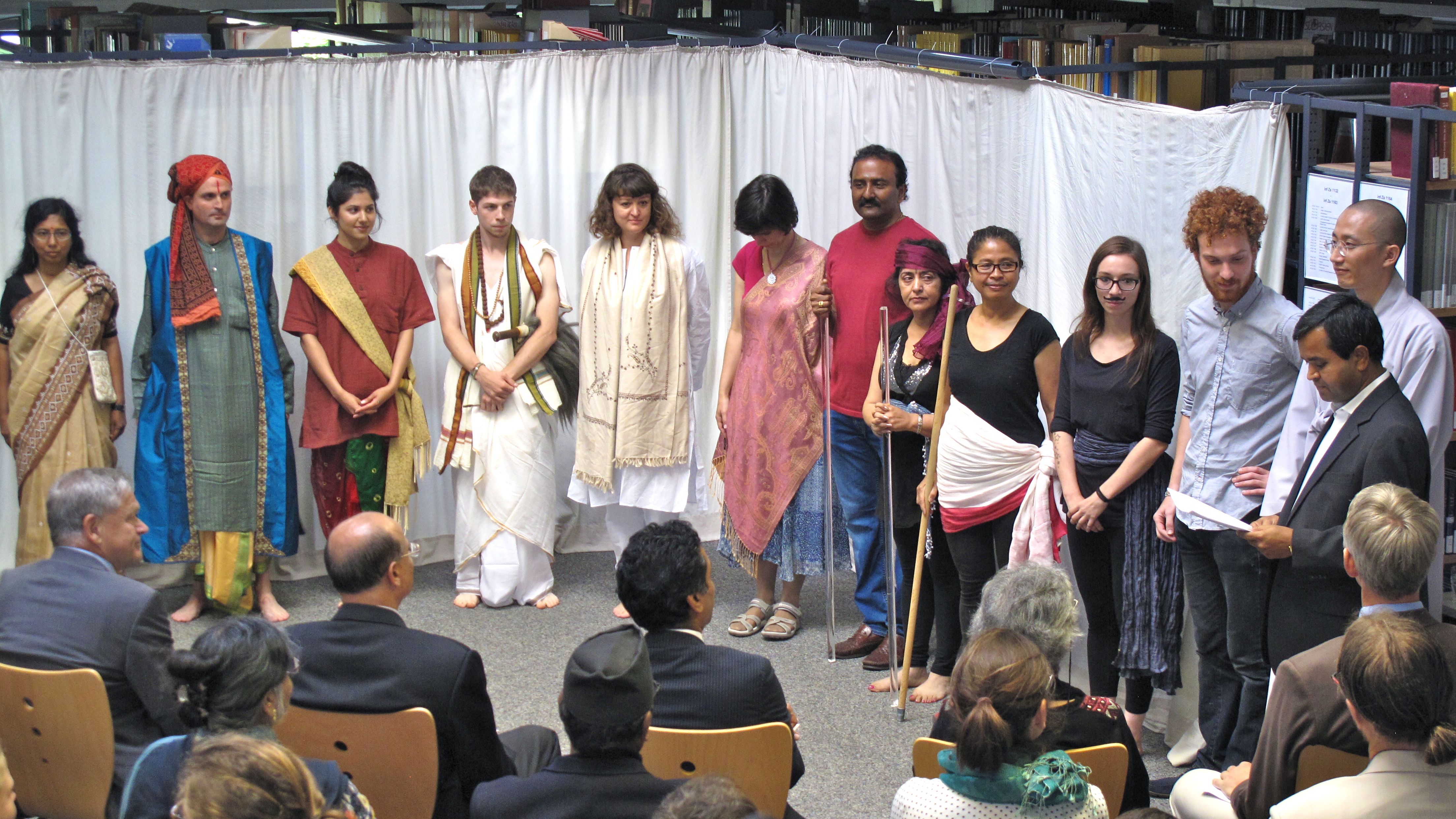
There were 20 of us in the class, learning, speaking and singing six days a week for four weeks. Several of my classmates were Indians living in Europe. Some were graduate students like myself, and others were professionals taking a break from work. There was even a Buddhist monk who out-chanted us all.
Much like any other intensive language course, we were expected to communicate only in Sanskrit. But where other immersion classes are for beginners, most of my classmates had years of experience reading the language. Of course, slowly translating a written work and rapid-fire conversation are completely different. Those who spoke Hindi, Bengali or Gujarati found the spoken Sanskrit a little more familiar than those of us who just read.
A connect-the-dots with Sanskrit numbers spelled out.
Credit: Patricia Sauthoff
We learned to speak through traditional methods like singing and chanting, but also by discussing everyday things. We learned lines of ancient poetry and had a Skype chat in Sanskrit with a professor in Australia. The students in my class were aware that the revival of Sanskrit is contentious. It's sometimes tied with the rise of Hindu nationalism. Events like the newly introduced Sanskrit Week are seen as privileging one language and culture over others. India’s second largest religion, Islam, does not have historical ties to Sanskrit. Even among Hindus, the country’s largest religious group, Sanskrit learning has historically been something for only the privileged castes. In the southern part of the country, languages such as Tamil developed simultaneously but separately from Sanskrit.
But in the classroom, we didn't discuss the current debates or the history of the language. Instead, we practiced for an upcoming performance of songs and a play for friends, family and the Indian ambassador to Germany.
Most of us study Sanskrit in order to read it, and learning to speak it was a challenge. My vocabulary includes a lot of technical philosophical terms that aren’t easy to translate into English, but it now also includes some useful everyday ones, too. I’m used to being able to slowly read complex books, but when it comes to quickly answering a basic question like कुशलम् अस्ति वा  kuśalam asti vā  — “How are you?” — I freeze.
After a month of class, I realized Sanskrit isn’t about self-expression for me. It’s about reading the ideas of the past. I’m glad I’ve gotten to experience it as a living language, but I’m more comfortable treating it as a dead one.
The World in Words podcast is on Facebook and iTunes. That's where you can also find a conversation with translator Terence Coe about Sanskrit's near-perfect alphabet.
National Endowment for the Humanities
With support from the National Endowment for the Humanities


see details

Saturday, 13 December 2014

Here's why Sanskrit is not a dead language and should be at the core of school curricula


Thursday, 11 December 2014 - 5:30pm IST | Agency: dna webdesk
  • http://static.dnaindia.com/sites/default/files/styles/thumbnail/public/11814.jpg?itok=C2G4P7kX
Why would anyone want to study Sanskrit? Is it not a dead language that no one speaks anymore? Of what use could it possibly be in this globalised age of informatics? Do we really want to be bogged down in the past when a brave, new world beckons? As one significant other put it, Sanskrit toh sirf pooja path ke liye hota hai (Sanskrit is only for religious rituals!) Surely, there must be more important things to learn?
This obtuse and philistine view has come to the fore since last month when India's Human Resource Development minister Smriti Irani, decided to replace German with Sanskrit as the third language in Kendriya Vidyalayas; German, however, would still continue to be offered but as a hobby. Furthermore, there appear to be some questions over how German came to be offered in the first place after a memorandum of understanding was signed between the Kendriya Vidyalaya Sangathan and the Goethe Institut in 2011.
Regardless of the bureaucratic irregularities, the question has now arisen whether Sanskrit, a relic of the past, should be made mandatory in schools at all. It is saddening to see such retrograde, utilitarian, and dare I say - insular - views being held by so many in prominent positions. There are umpteen reasons why Sanskrit should not just be taught but be at the core of school curricula alongside Maths and Science, and most of these reasons are accepted broadly about classical languages worldwide as Latin and Greek are offered in Europe and classical Chinese in China.
First, Sanskrit lays a firm basis for the rapid acquisition of other Indian languages. In a polyglot country such as India, the value of this skill cannot be overestimated. Not only is Sanskrit the root of many North Indian languages but it has also undeniably influenced South Indian Dravidian languages. A firm grasp over Sanskrit can improve cognition of words and ideas in several languages alien to the speaker. Can this not be done with other languages such as Urdu or Bengali? The short answer is no, not as effectively as with Sanskrit.
Second, Sanskrit is known for its highly ordered and efficient linguistic and grammar rules. The use of cases, dual plurals, and other features of Sanskrit forces students to be more precise in their use of language and develops logical and reasoning skills via sentence structure. A knowledge of Sanskrit helps in understanding not just the grammar of other Indian languages but also several foreign ones such as German, Russian, and Latin which, for example, also use cases and Arabic and Hebrew which have dual nouns.
Third, moving from crass utility to meta-utility, learning Sanskrit opens the door to the culture of ancient India. What richer source of literature, philosophy, and history - with the exception, perhaps, of Tamil - can there be for ancient and medieval India? Sanskrit literature is of many hues and not all of it is religious; there is secular work as well as erotic writings in the language which would do a world of good if popularised. Children will be able to access their favourite stories in the Mahabharata, Kalidasa's plays, and the poetry of Sriharsha. In other words, Sanskrit nourishes the inner world of the child. As their counterparts in Greece and elsewhere, the Sanskrit classics gently teach children virtues like honesty, fidelity, and courage which one hopes they will imbibe along with differential equations and pericyclic equations.
Perhaps one of the most important tasks the classics do is imbue a sense of community in children. One of the purposes of education in a state is to nurture citizenship. In a country as diffuse as India, Sanskrit remains one of the few things truly common to the overwhelming majority, if not all its people. Whatever differences Indians may have in their cuisine, language, or dress, they are all descendants of the same scholars, saints, and emperors. To deny that education plays this role or should play this role - usually through the Classics and History - is contrary to all known practice worldwide.
The most obtuse charge leveled against learning Sanskrit is that it in some way represents the 'saffronisation" of education. This is almost as bad as arguing that Sanskrit was once the language of the privileged and so it should not be taught today. There are many hues to this fear of the saffronistas. Yet, consider this: if a language is what radicalises a people, don't look now, but ISIS suddenly got a couple of hundred million new recruits! Thousands of Indian children living with their parents in the Middle East or Europe compulsorily learn Arabic or Latin and yet this hardly makes them more Muslim or Christian and less of their faiths. How is Sanskrit any different?
The greatest pity of it all is that everyone is talking about utility as early as primary and secondary education. Back in the day, school was meant to provide a child with a broad and liberal education which would enable him/her to tackle the world; it was university that was meant to professionalise young people and some wondered if that should not be postponed to graduate school. For now, one hopes that it can be agreed that school is too soon to think about utility.
Even if Sanskrit is useless, so what? How many newspaper editors in India use the calculus they learned in school at their jobs? Does any accountant care how to tell the difference between an aldehyde and a ketone? The thing about a good education is that one never knows how a tangential lesson may suddenly provide an answer to a problem in the present.
India's past is undeniably Sanskritic and the real question ought to be why Sanskrit was not emphasised more all these years. Learning the language does not produce Indian supremacist automatons any more than learning English makes everyone involuntarily genuflect towards the Windsors. Sanskrit gives access to a most incredible world called the past, and most delightfully, it rebels against the creation of mini-consumers as cogs in the world economy.